

Grid capacity, congestion, and infrastructure risk in decarbonising power markets
The International Energy Agency (IEA) estimates that at least 3,000GW of renewable projects are currently awaiting connection to national grids worldwide. This is equivalent to roughly three times the entire electricity generation capacity of the United States from all fuel types.[1},[2] The scale of this backlog highlights a critical vulnerability in the energy transition: electricity grid development is not keeping pace with renewable deployment.
Operational strain is already evident. In 2023, Spain spent more managing transmission congestion than investing in grid development.[3] Recent large-scale outages in southern Europe further demonstrate how shifting generation profiles, characterised by higher shares of intermittent renewable supply, are testing legacy grid architectures.
Electricity networks are emerging as a binding constraint on progress towards net-zero. System resilience increasingly depends on timely grid expansion, more complex system operations, and reliable project execution. Yet existing investment levels, planning assumptions, and regulatory frameworks were not designed to accommodate the speed and scale of change now required.
Renewable deployment is accelerating rapidly
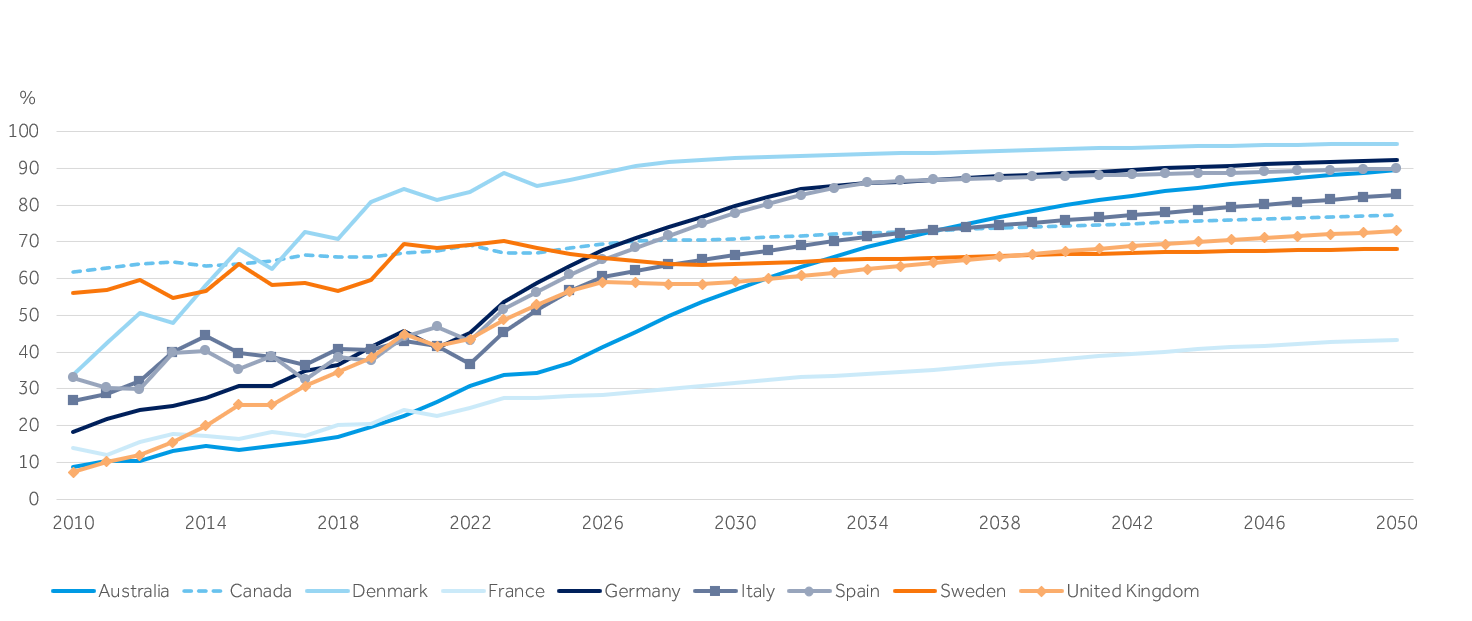
The penetration of renewable energy is increasing quickly across most major markets, although trajectories differ (Fig 1.). Denmark’s renewable share of electricity generation has risen sharply since 2010 and is projected to approach 97% by 2050. Australia’s is projected to climb from 37% in 2025 to around 90% by mid-century. The UK has also seen rapid growth since 2010, with further expansion expected over the coming decades. France, with its legacy nuclear-based electricity system, has maintained a lower renewable share, but this is projected to increase over the long term.
Fig. 1. Renewable share of electricity generation, 2010–2050
Renewables are reshaping grid geography
Unlike concentrated fossil fuel plants typically located near demand centres, renewable generation is geographically dispersed and often remote. As the IEA notes, the acceleration of renewable deployment requires modernised distribution networks and new transmission corridors to connect renewable resources located far from centres of consumption.[4]
In the UK, offshore wind capacity must nearly triple from 15.8GW in 2024 to meet the government’s 43-50GW target by 2030, increasing demand for long-distance, high-voltage onshore and subsea transmission infrastructure.[5] In January 2026, the UK awarded contracts to build a record 8.4GW of offshore wind.[6] Meanwhile, large-scale solar and onshore wind deployment in Spain and Australia is driving the need for extensive grid extension into remote regions with limited historical network coverage.
Grid expansion must accelerate
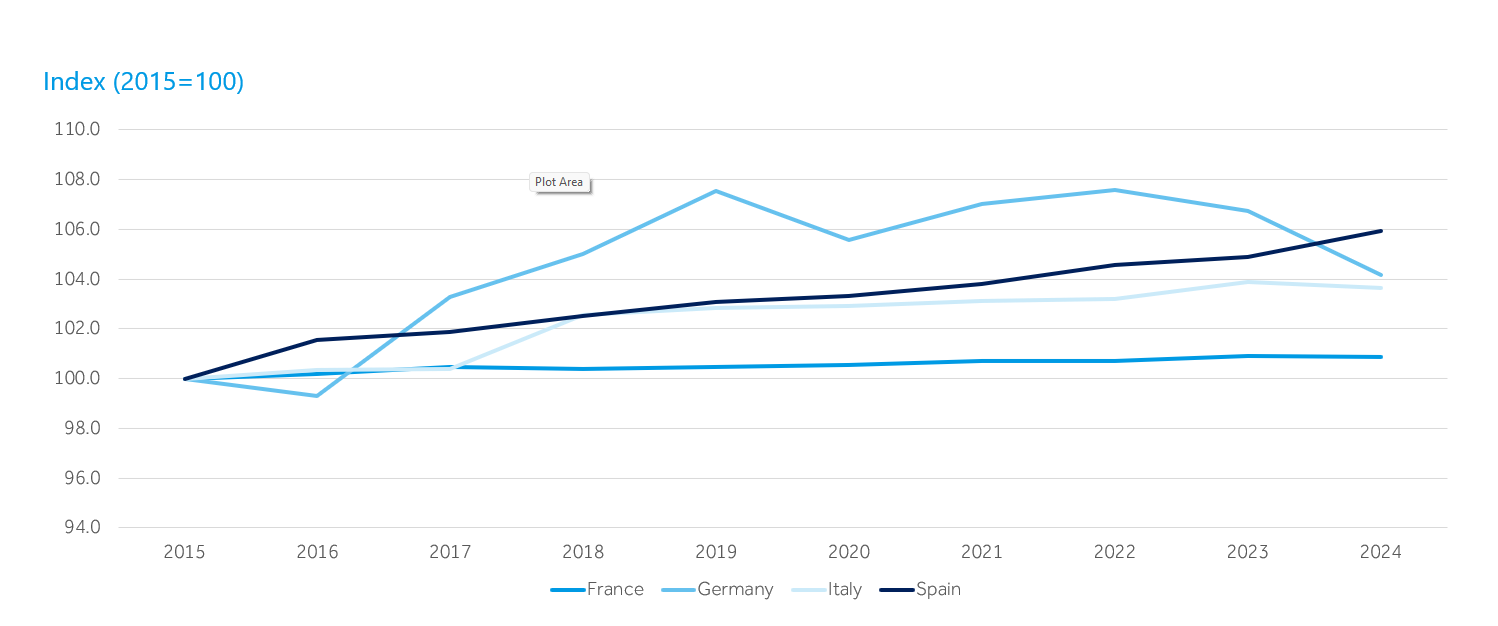
Historical transmission expansion has been relatively modest across Europe (Fig. 2). Between 2015 and 2024, the length of physical transmission lines increased by just 0.9% in France, 3.6% in Italy, 4.1% in Germany, and 5.9% in Spain. Germany has exhibited the greatest volatility, reflecting permitting challenges and delivery constraints associated with its north-south transmission corridors.
Fig. 2. Circuit length of national transmission grids, 2015–2024[7]
European transmission operators plan to add over 25,000km of new transmission lines between 2023 and 2026, increasing total network length by 5.3% – and nearly doubling the 13,000km delivered between 2015 and 2021.[8] Current plans also include around 34,000km of new lines and upgrades to a further 30,000km, exceeding what most major European networks achieved over the entire preceding decade.
However, even this step up may prove insufficient. The IEA estimates that advanced economies (and China) must replace or expand more than 120% of their existing transmission networks by 2035 to remain aligned with net-zero pathways.[9] By 2040, this would require 1.8 million km of transmission infrastructure, underscoring the unprecedented scale of investment required.
Investment and planning are falling short
Despite ambitious development plans, global grid investment has remained broadly flat since 2010 at around €280 billion annually.[10] In Europe, annual investment currently stands at approximately €63 billion, compared with an estimated requirement of €85 billion beyond 2030, to maintain pace with renewable deployment and decarbonisation objectives.[11]
This widening investment gap introduces execution risk, where delays in financing, permitting, or construction could constrain renewable integration, increase congestion costs, and amplify price volatility. This risk is compounded by underestimation of renewable deployment in planning frameworks, raising exposure to operational disruption and systemic stress across energy-intensive sectors.
Many European transmission plans are based on scenarios that significantly underestimate future renewable capacity.[12] Based on existing projections, planned network capacity could fall materially short of what is required to integrate forecast solar deployment alone, with an implied shortfall equivalent of around 205GW by 2030.
This mismatch between generation growth and grid readiness increases the likelihood of curtailment and connection delays and is likely to strain permitting schedules, engineering capacity, equipment supply chains, and skilled labour availability for asset owners and investors.
Underbuilt transmission infrastructure may also delay decarbonisation targets, adding regulatory pressure and risking sudden policy shifts. Investment shortfalls could slow private capital flows into renewable projects, while mounting delays compound operational stress on existing networks, creating a self-reinforcing cycle of underinvestment and increasing system fragility.
Congestion pressures translate to material system costs
Grid constraints are already generating significant financial consequences. In 2023, Spain spent approximately €2 billion managing transmission congestion, exceeding the investment in the transmission network itself, while Germany incurred close to €4 billion on congestion management alone in 2022.[13] These expenditures reflect structural and operational strain rather than temporary disruption.
Constraints are also driving rapid growth in renewable curtailment - the deliberate reduction of output when generation exceeds network capacity. Curtailment across Europe exceeded 10TWh in 2024 and is projected to reach 22TWh by 2030 across Great Britain, Spain and Italy alone.[14] The costs are already substantial, with €7.2 billion in lost generation value across seven European countries in 2024.[15]
Recent large-scale outages in Spain and Portugal in 2025 further illustrate how system complexity is increasing, exposing operational vulnerabilities. While individual incidents may have multiple contributing factors, higher shares of variable generation place greater operational demands on transmission networks and system operators.
Together, these trends underscore widening execution and resilience risk. Grids are being asked to expand faster, further, and with greater technical complexity than historical investment, planning, and regulatory frameworks were designed to accommodate. Without sustained grid investment and system modernisation, congestion costs, curtailment, and outage risk will only intensify, with implications for energy security, affordability, economic resilience - and the pace of the transition to net-zero.
1. International Energy Agency (IEA), "Electricity Grids and Secure Energy Transitions" , 2023, accessed February 2026
2. U.S. Energy Information Administration, "Electricity generation, capacity, and sales in the United States" , 2024, accessed February 2026
3. Ember, "Putting the mission in transmission: Grids for Europe’s energy transition" , 2024, accessed February 2026
4. IEA, "Electricity Grids and Secure Energy Transitions" , 2023.
5. Department for Energy Security and Net Zero, "Digest of UK Energy Statistics (DUKES): renewable sources of energy" , 31 July 2025.
6. Department for Energy Security and Net Zero, "Record breaking auction for offshore wind secured to take back control of Britain's energy" , 14 January 2026.
7. TSOs: Bundesnetzagentur, Red Eléctrica, RTE, Terna accessed February 2026
8. Ember, "Putting the mission in transmission: Grids for Europe’s energy transition" , 2024
9. IEA, "Building the Future Transmission Grid" , 2025, pp.14-15, accessed February 2026
10. IEA, "Electricity Grids and Secure Energy Transitions" , 2023
11. Ember, "Putting the mission in transmission: Grids for Europe’s energy transition" , 2024
12. As previous footnote
13. As previous footnote
14. Aurora, "Europe’s renewables buildout underpins €1.5 trillion investment opportunity by 2050" , 2026, accessed February 2026
15. Beyond Fossil Fuels, "How Europe's grid operators are preparing for the energy transition" , 2025, accessed February 2026