


Emerging cyber risks shaping business exposure, uncertainty and preparedness
Setting the scene
This year is shaping up to be at least as challenging as last. In fact, nearly half of risk analysts expect 2026 to be more challenging for business than last year, with great power competition as the most likely source of geopolitical risk.[1]
As geopolitical fragmentation continues, a ‘new normal’ of volatility and unpredictability requires deft management by businesses. Increased digital interconnectivity drives complexity, amplifying the speed, scale and impact of potential risk events and scenarios.
Regulation will continue to be fluid and politically driven; businesses will be subject to scrutiny by governments at home and abroad. There are significant differences in regulatory approaches across regions and businesses should be braced for more divergence on technology, data, AI and sustainability, with enforcement increasingly politicised.
Deep interconnectivity between risks also means the impact of specific risk events and scenarios could be felt in a variety of ways and across geographies.
Digital disruption, cyber and AI governance
Digital disruptions remain a top risk to organisations globally in 2026, as growing geopolitical tensions continue to intersect with financially motivated cyber campaigns.[2] New global data reveals that 58% businesses experienced a cyber event in the past 12 months and 57% of those suffered revenue loss as a result.[3]
The wider availability of AI tools will increase the frequency, sophistication and capability of such attacks, enabling faster reconnaissance, easier entry, more convincing social engineering and greater automation of cyber processes. Running parallel, 80% businesses are already using AI in their operations[4] – the mass rollout of AI into core systems, and increasing integration with third party suppliers, further expands available attack surfaces and increases interdependencies.
Recent threat intelligence indicates cyber intrusions are accelerating materially, reducing the time available to detect and contain incidents from hours to minutes. Attackers are using widely available AI tools to scale phishing, reconnaissance, and evasion, while also targeting AI and cloud environments directly. The net effect is higher likelihood of rapid business disruption, data loss, and financial impact unless identity, cloud, and exposure management controls keep pace. As a result, 72% businesses expect cybersecurity budgets to increase and with 37% specifying a rate beyond inflation.[5]
2025 trends reported by CrowdStrike across 280+ tracked adversaries:
• Intrusions are faster: average breakout time reported at 29 minutes (fastest observed 27 seconds)
• Data can leave quickly: within four minutes in one case
• Growth in AI-enabled activity: 89% increase year-on-year, with AI used for reconnaissance, credential theft, and evasion
• Cloud and identity pathways are central: cloud-conscious intrusions up 37% and cloud targeting/intelligence collection up 266%
• Social engineering volume rises: 563% increase in incidents using fake CAPTCHA lures and a 141% increase in spam emails [6]
• Financial impact is high: a single reported crypto theft was valued at USD $1.46B
Source: CrowdStrike: Global Threat Report [7]
Meanwhile, governments are playing catch up with both threat actors and technology developments, leading to a flurry of new regulation across cyber security, data protection and AI governance.[8] Regulations differ greatly across global regions with notable developments in ransom payment oversight and reporting, AI usage in critical industries and ongoing expansion of data categories that may be subject to regulatory penalties. This creates a complex and fast evolving compliance environment, especially for businesses with multinational operations.
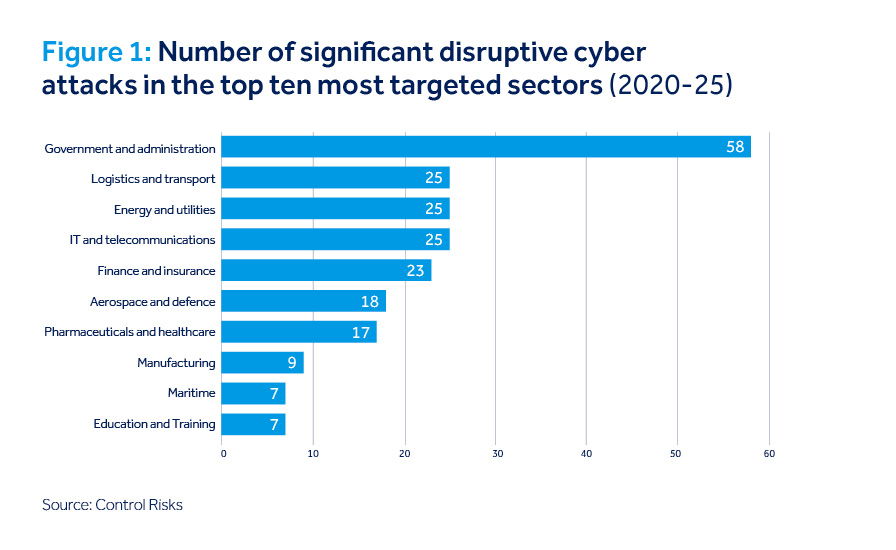
[9]
Agentic AI accelerates and multiplies attacks
The growing use of agentic AI [10] is creating new opportunities for organisations to improve efficiency and automate complex workflows. However, it also introduces new forms of exposure, making unprotected businesses an attractive target – and tool – for cyber threat actors.
The shift to agentic AI marks a structural change in AI adoption and deployment for businesses. Unlike the previous, more passive tools, agentic systems can act autonomously, making complex decisions in operational processes. As these systems become more deeply embedded in day-to-day operations and workflows, the potential impact of disruption increases.
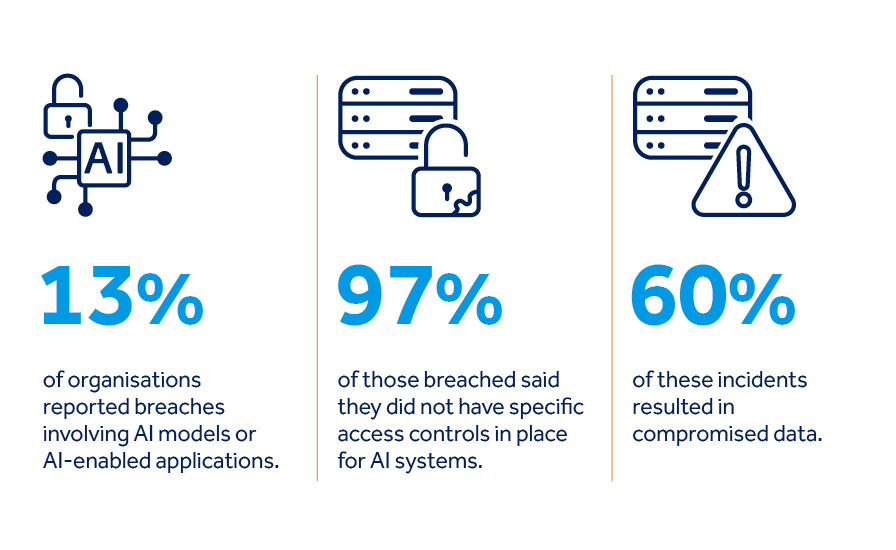
Threat actors are increasingly using AI agents to speed up and scale cyber attacks, allowing them to operate beyond the capabilities of humans. In the short term, this is likely to benefit threat actors who already have access, infrastructure and intent to carry out complex attacks, including state-linked groups and highly organised criminal networks.
However, as AI tools become easier to access and use, more actors across the threat landscape are likely to adopt them, lowering barriers to entry and increasing both the speed and volume of attacks.
In November 2025, Anthropic reported on an espionage campaign attributed to a threat actor likely operating from China, which made extensive use of the Claude Code tool. [14] The activity targeted around 30 organisations worldwide, in sectors including technology, financial services, manufacturing and government.
According to Anthropic, the actor used Claude’s agentic AI capabilities to autonomously carry out 80–90% of tactical actions against designated targets, with human input largely confined to higher level decision making. This allowed the attack to be conducted faster than would typically be possible using human operators alone.
However, Anthropic also found that the AI system, Claude, generated inaccurate information and regularly overstated its findings, which are likely to have dampened the effectiveness of the incident and slowed progress against some targets.
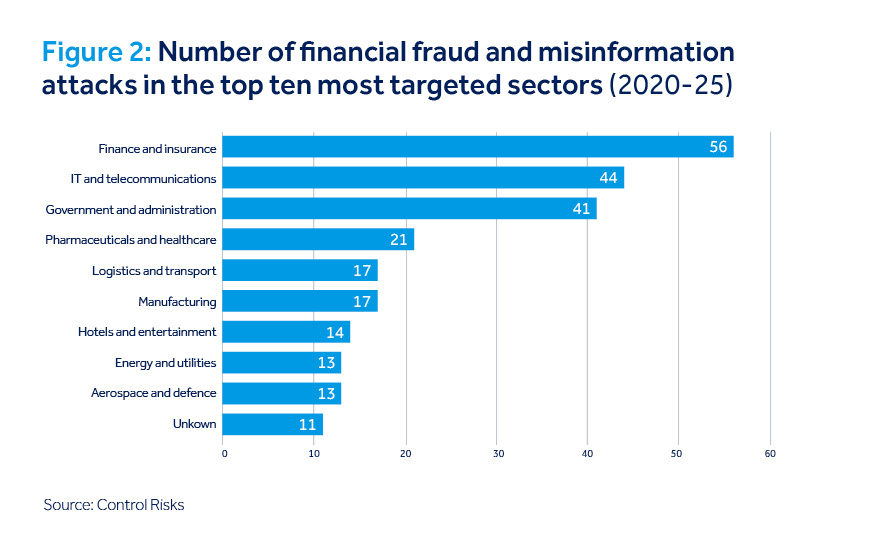
Lower capability and/or opportunistic threat actors will continue to experiment with widely available AI tools to target organisations through financial fraud and misinformation campaigns. Sectors such as financial, IT and telecommunications, and government remain among the most frequently targeted for such attacks (see Figure 2). AI generated deepfakes are being used to spread false narratives that undermine trust in organisations and damage reputations.
Meanwhile, these tools are enabling more direct financial crime. For example, deepfake video or audio messages impersonating senior executives can be used in payment diversion campaigns, in which employees are tricked into transferring funds to accounts controlled by attackers.
Threat actors used an AI-generated deepfake video of Canadian Prime Minister Mark Carney, presented as a staged CBC interview, to promote a fraudulent cryptocurrency scheme. [16] The video used familiar broadcaster branding to raise credibility and directed victims to a scam website that had already been flagged by regulators at the Manitoba Securities Commission. Victims were coached into making real-time bank transfers and were shown simulated profits to build trust, before freezing invested funds and ignoring withdrawal requests. While it’s reported that Canadians have lost more than CAD 388m through deepfake fraud schemes, it is estimated that only 10% of victims have reported their case.
Cloud environments expand attack surface
The wider adoption of AI, cloud services and digital transformation programmes continues to expand organisations’ exposure to cyber risk. Cloud environments now store large amounts of sensitive corporate and personal data, and support critical operational processes, making them highly attractive targets for disruption and data theft. Reliance on third parties further increases exposure; in 2025, 35% of identified cyber attacks were linked to third-party compromises, up from 25% in 2024,[17] highlighting the growing importance of access controls.
Heavy reliance on a limited number of large service providers increases exposure to concentration risks[18] and amplifies the impact of disruption when it happens. Dependence on a limited number of cloud providers means that failures can create system-wide ripple effects rather than isolated incidents for organisations.
Disruption, whether due to a technical failure, cyberattack, or geopolitical action, can quickly spread across multiple sectors and geographies. And while a business may not directly engage with a compromised cloud provider, they could still be at risk through third-party engagement. It’s vital that firms recognise vulnerabilities in growing interconnectivity by adapting risk mitigation strategies, introducing appropriate guardrails and protecting sensitive data.
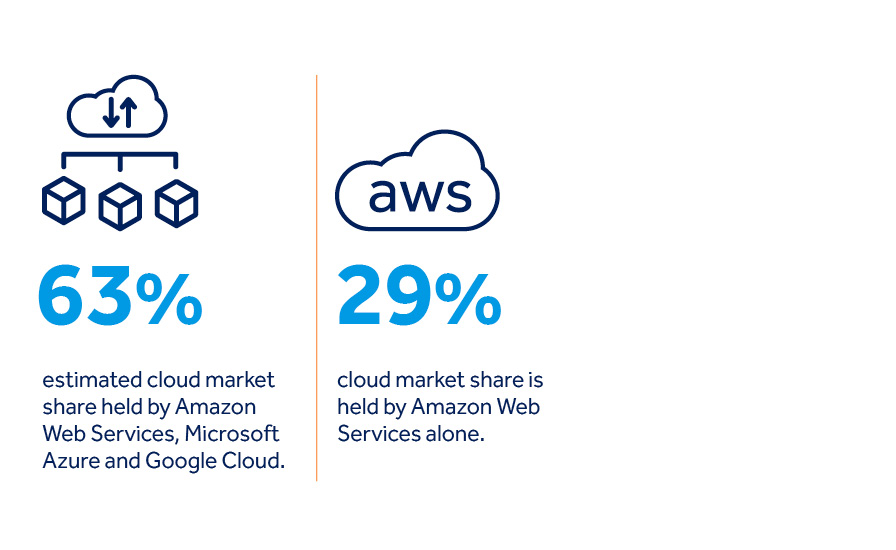
Outages impacting AWS in October 2025 caused disruption for organisations across multiple sectors and regions. Separately, the internet infrastructure firm Cloudflare’s suffered a major outage in November that affected its global network, which provides content delivery, security, and performance services to more than 13,000 networks worldwide.
While unrelated, the two incidents highlight the concentration risk created by reliance on a small number of highly connected cloud service providers. When disruption occurs, the impact spread rapidly across regions and sectors affecting larger numbers of businesses at the same time.
Global regulatory and compliance shifts
Geopolitical and trade tensions are driving diverging approaches to data localisation, digital sovereignty and AI directives, resulting in growing compliance costs and legal uncertainty for multinational organisations operating across borders.
Governments are responding with an expanding patchwork of cyber security, operational resilience and AI governance regimes - including the EU’s NIS2 Directive, the Digital Operational Resilience Act (DORA), and the EU AI Act, alongside enhanced disclosure and resilience requirements in the US, UK and Asia‑Pacific.
As governments place tighter controls on access to foreign technology and require data to be stored or processed locally for national security reasons, organisations are required to adapt both their operating models and compliance frameworks, often at pace. While these frameworks aim to raise baseline resilience and accountability, their differing scopes, timelines and enforcement models are creating a complex compliance environment, particularly for multinational organisations
Germany and France have signalled a stronger focus on technological sovereignty. German Chancellor Friedrich Merz and French President Emmanuel Macron met in November 2025 for a summit focused on strengthening Europe’s control over critical digital infrastructure and technologies.
This direction reflects a wider shift across advanced economies: governments including the UK, US, Australia and Sweden have already introduced, or announced plans to bring in, restrictions on the use of certain foreign technology manufacturers and suppliers in sensitive areas such as government networks or 5G infrastructure, citing national security concerns.
More broadly, the lag between capability and regulation will have business implications across procurement, system design and long-term investment decisions.
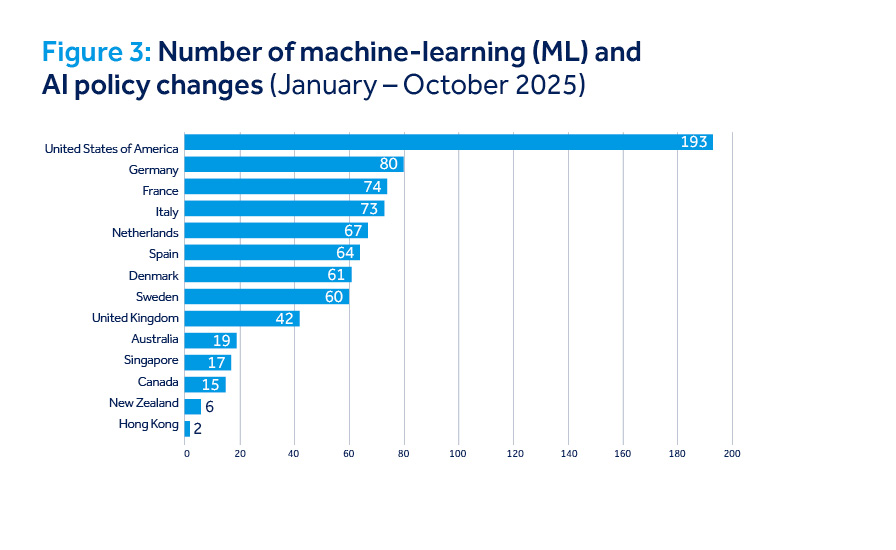
Simultaneously, gaps in standards and oversight may expose companies to security, governance and compliance risks as they adopt new tools. In 2025, more than half of the AI and machine-learning (ML) policy activity focused on design and testing standards, data governance and consumer protection, showing where regulators are concentrating their efforts.[22]
Organisations evaluating their risk exposure to cyber attacks should consider both external and internal factors that are likely to impact their operations, staff or critical third parties in specific countries. This should include an assessment of the country’s cyber threat rating where they are located, as geopolitical tensions, regulatory environments and regional threat actors will impact the threat landscape. Such external threats must then be evaluated against internal organisational controls to mitigate against priority threats. A high-threat jurisdiction combined with weak cybersecurity maturity will amplify risks.
Risk interconnection
The most significant risks have not been growing in isolation. The data points to an evolving pattern of risk convergence, where cyber events or geopolitical shocks in one area rapidly amplify pressure in others. While advances in artificial intelligence reshape cyber risk and information integrity, geopolitical competition intensifies - and political volatility and regulatory differences increase exposure in digital and interconnected operations. Whichever risk group analysed, reinforcing patterns of interconnection stand out.
AI-enabled tools are accelerating the spread of misinformation, fraud and cyber intrusion, while geopolitical tensions are raising the incentives to use these tools more aggressively. State-linked threat actors and criminal networks are already exploiting AI to automate attack activities at scale.[23]
In parallel, some countries are under mounting pressure to align with rapidly evolving technology and data capabilities which also increase exposure to policy shifts, sanctions and regulatory fragmentation. As a result, information risk is no longer confined to cyber security teams but is increasingly shaped by geopolitical positioning, regulatory decisions and foreign policy dynamics.[24]
As organisations become more dependent on cloud services, AI-enabled systems and third-party providers, disruption in one part of their digital network can quickly ripple across sectors and borders. Often unable to keep pace with advancements, governments are taking increasingly divergent approaches to technology regulation, digital sovereignty and data control.
This combination is increasing systemic vulnerability. Regulatory fragmentation, concentration risk and cyber exposure reinforce one another, making it harder to isolate incidents or contain their impact. Even organisations that are not directly targeted may still be affected through suppliers, partners or shared infrastructure.[25]
Boards will need to guarantee that risk management and strategies are aligned with the external environment, ensuring that an accurate understanding of emerging risk exposure underpins decision-making, and that interconnectivity is incorporated into management planning.
This report has been produced in partnership with Control Risks.
References
[1] Control Risks polled its team of specialists in country, geopolitical and digital risks to ask for their views on the risk outlook for 2026. Q: Do you expect 2026 to be more/less/equally as challenging for business than last year? 47% selected ‘more challenging’, the largest share.
[2] https://www.theiia.org/en/content/articles/tone-at-the-top/2026/the-evolving-risk-landscape-for-2026/
[3] https://qbeeurope.com/news-and-events/reports/1-in-3-businesses-experience-ai-enabled-cyber-attacks-qbe-research/
[4] https://qbeeurope.com/news-and-events/reports/1-in-3-businesses-experience-ai-enabled-cyber-attacks-qbe-research/
[5] https://qbeeurope.com/news-and-events/reports/1-in-3-businesses-experience-ai-enabled-cyber-attacks-qbe-research/
[6] CAPTCHA is an acronym for: Completely Automated Public Turing test to tell Computers and Humans Apart. A CAPTCHA test is designed to determine if an online user is really a human and not a bot (a software programme operating on the internet, performing repetitive tasks) or spam (messaging systems sending multiple unsolicited messages). CAPTCHA and reCAPTCHA tests are used to deter bot attacks and spam.
[7] https://securitybrief.co.uk/story/ai-fuelled-cyber-attacks-hit-in-minutes-warns-crowdstrike
[8] https://www.whitecase.com/insight-our-thinking/ai-watch-global-regulatory-tracker
[9] Results reflect data collection for UK, Denmark, Sweden, France, Germany, Spain, Italy, Netherlands, US, Canada, Australia, New Zealand, Singapore and Hong Kong
[10] Agentic AI refers to AI systems designed with autonomy, goal-directed behaviour, and the ability to make decisions and take actions proactively in dynamic environments. Unlike traditional AI, which typically reacts to inputs or follows predefined rules, agentic AI can initiate tasks independently, adapt strategies in real time, and pursue objectives without constant human oversight.
[11] ps://newsroom.ibm.com/2025-07-30-ibm-report-13-of-organizations-reported-breaches-of-ai-models-or-applications,-97-of-which-reported-lacking-proper-ai-access-controls
[12] ps://newsroom.ibm.com/2025-07-30-ibm-report-13-of-organizations-reported-breaches-of-ai-models-or-applications,-97-of-which-reported-lacking-proper-ai-access-controls
[13] https://newsroom.ibm.com/2025-07-30-ibm-report-13-of-organizations-reported-breaches-of-ai-models-or-applications,-97-of-which-reported-lacking-proper-ai-access-controls
[14] https://assets.anthropic.com/m/ec212e6566a0d47/original/Disrupting-the-first-reported-AI-orchestrated-cyber-espionage-campaign.pdf
[15] Results reflect data collection for UK, Denmark, Sweden, France, Germany, Spain, Italy, Netherlands, US, Canada, Australia, New Zealand, Singapore and Hong Kong
[16] https://www.cbc.ca/news/canada/saskatchewan/prime-minister-mark-carney-ai-cryptocurrency-scam-prince-albert-sask-9.6975464
[17] securityscorecard.com/wp-content/uploads/2025/03/SSC-Third-Party-Breach-Report_031225_03.pdf
[18] Concentration risk refers to the risk that arises when critical IT infrastructure or services are overly dependent on a limited number of providers, regions, or facilities.
[19] https://www.srgresearch.com/articles/cloud-market-share-trends-big-three-together-hold-63-while-oracle-and-the-neoclouds-inch-higher
[20] https://www.srgresearch.com/articles/cloud-market-share-trends-big-three-together-hold-63-while-oracle-and-the-neoclouds-inch-higher
[21] https://digitalpolicyalert.org/economic-activity/ml-and-ai-development?jurisdiction=36,124,208,251,276,344,381,554,702,724,752,826,840&period=2025-01-01,2025-10-23
[22] https://digitalpolicyalert.org/economic-activity/ml-and-ai-development?jurisdiction=36,124,208,251,276,344,381,554,702,724,752,826,840&period=2025-01-01,2025-10-23
[23] https://apnews.com/article/ai-cybersecurity-russia-china-deepfakes-microsoft-ad678e5192dd747834edf4de03ac84ee
[24] https://reports.weforum.org/docs/WEF_Global_Risks_Report_2025.pdf
[25] https://www.chathamhouse.org/2024/01/towards-global-approach-digital-platform-regulation