

- Lithium-ion battery fires reached 4.8 per day in 2025
- Incidents have risen 147% in three years
- Call for greater awareness of risks
UK fire brigades are now tackling a lithium-ion battery fire once every five hours (equivalent to 4.8 fires a day), according to new research from global business insurer QBE. The number of lithium-ion battery fires continues to rise year on year, up 147% since 2022. By comparison, in 2022 fire brigades dealt with the equivalent of two lithium-ion fires a day.
QBE is calling for greater awareness of lithium-ion batteries by sharing tips on safe charging, storage and disposal in order to minimise risk and keep people and property safe.
 Source: QBE
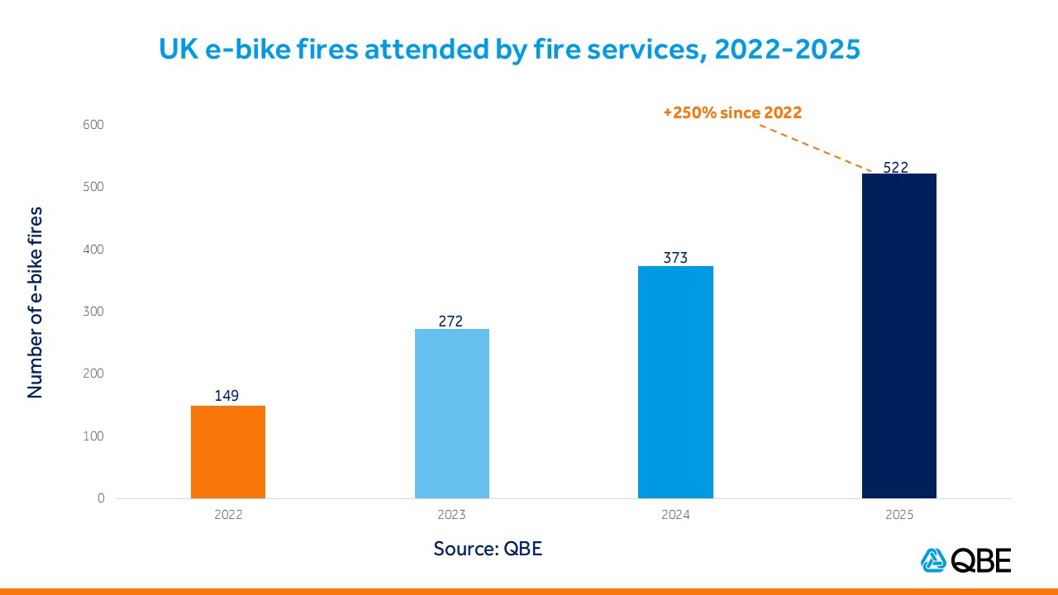
E-bikes accounted for 520 fires in 2025, more than tripling since 2022 and making up close to a third (around 30%) of all lithium ion battery fires recorded that year. Of these, 44% were tackled by the London Fire Brigade, with 230 e-bike fires occurring in the capital last year. Where fire services recorded this information, converted or retrofitted e bikes were involved more frequently than officially manufactured models, reinforcing the importance of purchasing certified products from reputable retailers.
Fires involving electric vehicles (EVs) increased by 133% (120 to 279) between 2022 and 2025, however the number of electric vehicles on the road tripled over the same period (+206%), from 664,148 EVs to 1,971,764 EVs1 .
In terms of location, almost half (46%) of lithium-ion battery fires took place in people’s homes, while 31% occurred outdoors and 23% were recorded in commercial properties.
Lithium-ion batteries power most rechargeable devices, from smartphones and laptops to power tools, solar panels and electric vehicles. Lithium-ion batteries are ubiquitous with a typical household often containing 15–25 battery powered devices, sometimes more. Notably, 45% of fire incidents involving lithium-ion batteries occurred on devices such as mobile phones, tablets, power packs and other battery powered equipment.
Lithium-ion battery fires are the result of “thermal runaway” which is a chemical reaction where batteries start to irreversibly overheat, usually due to impact damage, over-charging or over-heating. Thermal runaway is unpredictable and ignites fires that spread faster and take far longer to tackle than ordinary combustion, increasing the risk of injury and damage to property.
Adrian Simmonds, Risk Manager at QBE Insurance said: “Lithium-ion battery fires continue to increase. It’s vital that people and businesses take action to better manage this growing risk. Thermal runaway caused by these types of batteries burns differently, takes much longer to tackle and can require up to 10 times more water to contain.
“Awareness of safe charging, storage and disposal is essential to keeping people and property safe. People should use only certified e-bikes and batteries, charge them away from escape routes and avoid charging items overnight.
“The statistics suggest retrofitted bikes are more prone to these incidents, so we would encourage people to stick to reputable companies when purchasing and avoid unregulated devices.”
Of all the fire services in the UK, the London Fire Brigade recorded the highest number of lithium-ion battery fires in 2025, with 522 incidents, making up nearly a third (30%) of the fires last year. This is followed by West Yorkshire Fire and Rescue Service, reporting 126 lithium-ion battery fires, and Lancashire Fire and Rescue Service, reporting 117 fires.
Bedfordshire and Luton is the only fire service to have reported a year-on-year reduction in lithium-ion fires. This coincided with the fire service’s updated e-bike and e-scooter safety guidance in 2023. Despite positive trends in some regions, these fires are still increasing at a significant rate across the UK, reinforcing the need to guard against them.
The UK granted royal assent to the Product Regulation and Metrology Act in July. The Act enables the UK Government to overhaul product safety regulations, specifically targeting emerging dangers from uncertified products, including e-bikes, from online marketplaces.
QBE's recommendations for managing lithium-ion batteries at home:
- Buy certified devices from reputable retailers.
- Check for battery damage after impacts or accidents.
- Use only the original charger provided with the device.
- Plug into outlets with circuit breakers.
- Charge in well-ventilated, outdoor areas away from combustible sources (for example, barbecue gas cylinders).
- Avoid charging in escape routes like hallways for apartment buildings.
- Indoors, charge in low-risk areas (such as kitchens with smoke detectors) away from combustibles.
- Install smoke or heat detectors where devices are charged.
- Don’t charge unattended or while sleeping.
- Unplug devices when charging is complete.
QBE's recommendations for managing lithium-ion batteries as a business:
- Buy certified devices from reputable suppliers only.
- Inspect batteries regularly for swelling, dents, or damage. Dispose of damaged ones safely via professional battery recycling services.
- Store batteries safely in non-combustible, ventilated areas with proper spacing.
- Use approved chargers and charge only during business hours.
- Keep ignition sources away from charging or recently used batteries.
- Avoid extreme conditions like heat, cold, moisture, or stacking heavy items on batteries.
- In case of fire or overheating, evacuate immediately and call emergency services—do not use fire extinguishers other than to assist evacuation.
- Use infrared (IR) thermography to monitor for temperature spikes indicating battery issues and triggering an emergency response.
- Have an emergency response plan in place and train all staff before allowing batteries on-site.
- Recycle responsibly. Never open, incinerate, or destroy batteries. Take batteries to certified recycling points or hazardous waste collection centres.
QBE made a Freedom of Information (FOI) request on 20 February 2026 to all 49 UK fire services, receiving data from 42 of them as of 21 April 2026.
1. UK ev market share 2026: latest electric car registration stats | zapman